
Introduction: Why smart technology is not just hype
Imagine your home sensing that you’re arriving before you do — adjusting lights, unlocking the door, preheating your shower. That kind of anticipation is no longer science fiction. Today, the wave of smart technology innovations is pushing that kind of capability into everyday life. As we move into 2025, the smart tech landscape is shifting dramatically — from mere automation to intelligent adaptation, from connected gadgets to pervasive, invisible intelligence.
In this post, we’ll explore the most compelling emerging trends in smart technology for 2025 — not just what’s new, but what’s meaningful, what’s challenging, and what’s truly transformative. Let’s look beneath the buzzwords to see where the real action is.
What’s changed: past vs. present smart tech
Before diving into 2025, it helps to contrast where smart tech was and where it’s heading:
| Era | Focus | Limitation | 2025 Shift |
|---|---|---|---|
| Smart gadgets & isolated automation | Devices controlled manually or via simple rules | Siloed systems, manual triggers | Intelligence embedded, cross-device orchestration |
| Connected IoT & cloud | Devices talk to the cloud, data collection | Latency, bandwidth constraints, centralized bottlenecks | Edge compute, AI at the edge, privacy-preserving models |
| 2025 and beyond | Adaptive, context-aware, autonomous systems | Governance, trust, energy demands | Agentic AI, spatial computing, hybrid architectures |
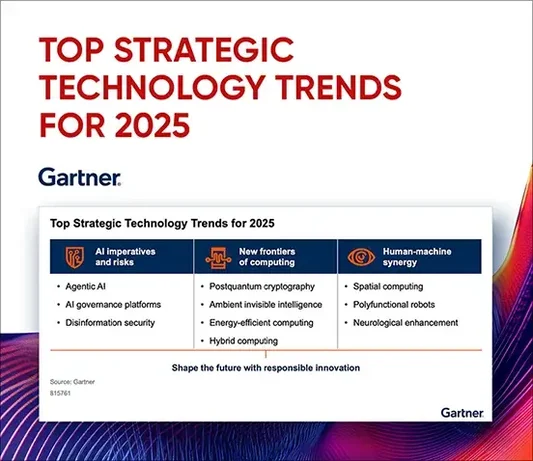
According to McKinsey’s Technology Trends Outlook 2025, we’re seeing this move from pilot modes to real deployment of “autonomous systems” that learn, adapt, and cooperate. (McKinsey & Company) Meanwhile, Gartner names trends such as Agentic AI, Hybrid Computing, and Ambient Intelligence as core to the 2025 strategic landscape. (Gartner)
Now let’s dig into the key trends.
Key Emerging Trends in Smart Technology (2025)
1. Agentic AI — when smart agents act for you
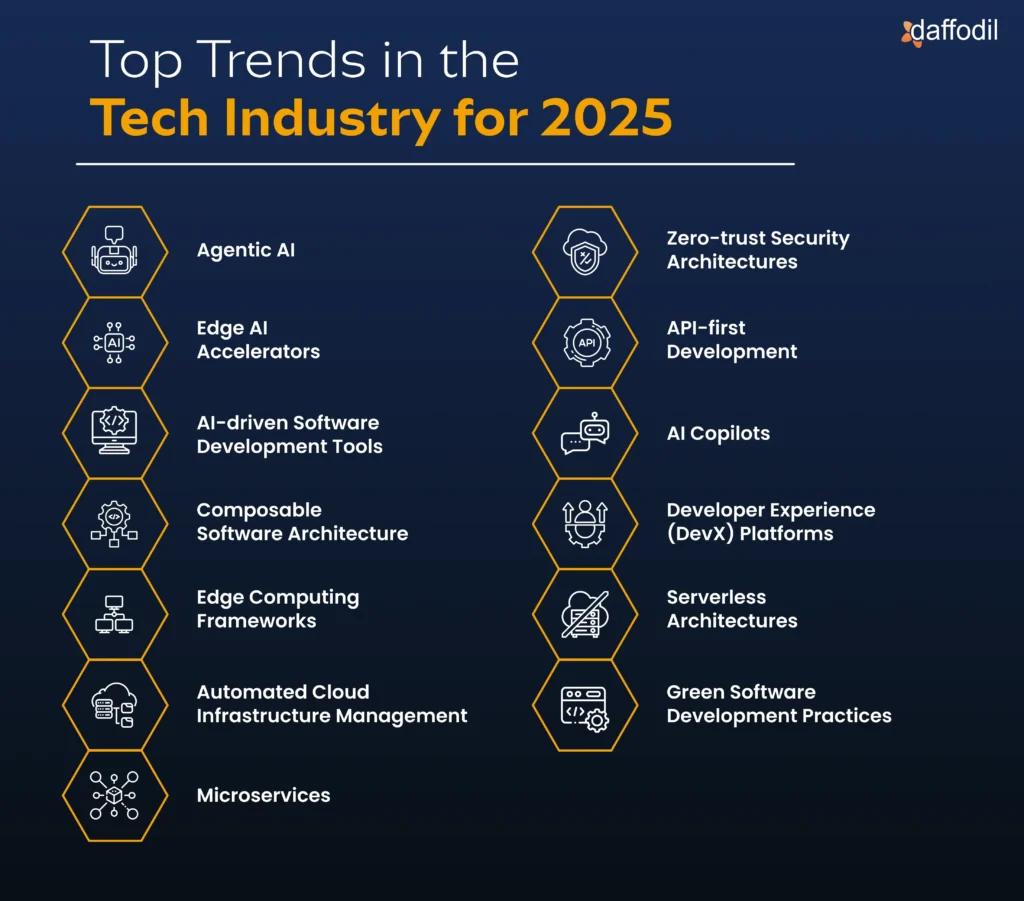
In 2025, we’ll see “agentic AI” — systems that don’t just take commands but act autonomously to fulfill goals. Rather than asking, “Turn on my lights,” you might say, “Set a cozy evening for me,” and the system coordinates lighting, music, temperature, and even content suggestions to execute that vision. Gartner predicts that Agentic AI will be a defining trend in 2025. (Gartner)
These agents will do more than follow rules — they’ll reason, adapt, and even recover from failures. In your home, this could mean your smart assistant noticing no one is home and temporarily lowering energy use, or your car rerouting itself to avoid delays. The intelligence moves from you commanding to the tech understanding and anticipating.
Challenges & opportunities: Trust and explainability become vital. If autonomous agents make errors, users must be able to understand why. Investment in AI governance will accompany growth.
2. Spatial computing & immersive interfaces
We’re entering the world of spatial computing — where digital and physical blend seamlessly. Think AR glasses overlaying navigation cues on your real-world path, or virtual screens floating in your environment. Deloitte flags spatial computing as a major pivot: over time, interactions will feel less like using a “device” and more like interacting with reality itself. (Deloitte)
From smart glasses to AR headsets and mixed-reality home assistants, interfaces will shift toward voice, gesture, and eye tracking. The tech doesn’t just respond — it becomes present.
Use case spotlight: Imagine mechanics using AR headsets to visualize digital overlays on complex machinery, or surgeons navigating holographic consoles mid-operation.
3. Edge AI & hybrid/efficient computing
Centralizing all processing in cloud data centers is no longer sufficient. The explosion of data from devices, IoT sensors, and immersive environments demands edge AI — computing closer to the source to reduce latency and preserve privacy. (Wikipedia)
But it doesn’t stop there: hybrid architectures—blending edge, cloud, and specialized accelerators—are becoming essential. Gartner also highlights hybrid computing as a trend: task-specific chips, distributed models, and more energy-efficient compute will reshape design. (Gartner)
Real insight: In your smart home, local AI models can handle urgent tasks (e.g., intruder detection) while conditional workloads (e.g., behavior analytics) offload to cloud systems — balancing speed, cost, and privacy.
4. Ambient / invisible intelligence
Smart tech is shedding the “gadget” label entirely and becoming ambient — embedded in surfaces, objects, and environments. Gartner calls this “ambient invisible intelligence.” (Gartner)
Imagine walls that subtly adjust opacity or lighting based on your mood, roads that respond to traffic patterns in real time, or floors that detect presence to guide energy use. The goal: adapt without explicit requests, blending utility with seamless experience.
Why it matters: When technology fades into the background, humans experience it rather than manage it. The friction disappears.
5. Post-quantum & secure architectures
As smart systems become more pervasive, they also become high-value targets. In 2025, post-quantum cryptography is becoming critical — crafting protocols that withstand quantum attacks. Gartner includes it in the 2025 trends. (Gartner)
Moreover, trust architectures — decentralized identity, secure enclaves, federated learning — will underpin the new baseline for smart systems. Smart technology must be trustworthy to be adopted widely.
Application: A smart device will not only encrypt messages but verify firmware updates cryptographically and prove identity in decentralized networks.
6. Smart ecosystems & device cooperation
Devices won’t act as islands. In 2025, ecosystems of smart tech — devices cooperating and negotiating — become stronger. Your oven might talk to your energy monitor; your car to your home; city sensors to your appliance network. The intelligence lies in collaboration.
Case study: Smart cities integrating mobility, environmental sensors, and home automation can dynamically respond to pollution spikes, traffic surges, or energy stress.
7. AI & IoT convergence (AIoT)
The fusion of AI + IoT, or AIoT, means connected sensors that aren’t just reactive but predictive. AI empowers IoT devices with real-time analytics, anomaly detection, and autonomous decisioning. Comcast Business describes this as one of the key trends shaping 2025. (Comcast Business)
In a smart building, sensors might detect vibration, temperature, and usage patterns to forecast equipment failure — then self-schedule maintenance autonomously.
8. Smart health & wearables (next-level sensing)
Wearable tech is maturing fast. According to Seamless Integration: The Evolution, Design, and Future Impact of Wearable Technology, wearables are evolving with AI, AR, and more sophisticated sensors integrated into daily life. (arXiv)
Emerging forms:
- Earables: devices in or around the ear that go beyond audio — biometric sensing, gesture recognition, context awareness. (arXiv)
- Smart rings: 2025 is seeing increased adoption of rings tracking health metrics like heart rate, temperature, sleep, and more. (Investors)
- Smart mirrors, skin sensors, adaptive wearables: your mirror might analyze health biomarkers while you brush your teeth, or fabrics might sense inflammation.
The boundary between health care and everyday life is thinning.
9. Energy & resource-smart systems
Smart technology is also turning toward sustainability. Energy management systems, adaptive grids, and intelligent cooling/heating govern usage more precisely. McKinsey cites energy and sustainability technologies in its frontier trends. (McKinsey & Company)
Emerging work in quantum-enhanced digital twins for the power grid explores how quantum algorithms can accelerate simulation and optimization. (arXiv)
In homes, smart thermostats will converge with smart grids to buy electricity when it’s cheap or green, reducing costs and carbon. In cities, infrastructure will react to demand volatility — balancing supply, storage, and usage.
10. Autonomous systems & robotics
Finally, smart technology will increasingly express itself through autonomous systems — robots, drones, delivery agents, and autonomous vehicles operating with minimal human input. McKinsey explicitly lists this as a trending frontier. (McKinsey & Company)
These systems won’t just follow paths — they’ll perceive, decide, and adapt. Delivery drones that dodge obstacles, warehouse bots that learn new layouts, or agricultural robots monitoring crops — the intelligence drives action in the physical world.
My personal angle: designing for ambient trust
In my consulting work with startups, I’ve seen the shift from “smart features” to “experience intelligence.” One project involved a home sensor that monitored plant moisture, light, and air quality. At first, it just alerted via app. But we evolved it to autonomously adjust ambient lighting, micro-irrigation, even predictive fertilizer dosing — all while gradual, user-transparent.
The real insight: trust is built when users feel safe to let go. As systems become ambient, you have to earn permission to act on the user’s behalf. Transparency, gradual control handoff, and clear feedback loops are essential. Regarding 2025 workflows, the design challenge becomes not “What can the system do?” but “What should it do — and when should it intervene?”
How to prepare (for businesses, creators, and users)
- Design for autonomy with guardrails. Build systems that can act, but always allow human override and explainability.
- Prioritize edge & hybrid compute. Don’t wait until centralized systems choke — start balancing load and intelligence distribution.
- Adopt interoperable standards. In smart home and IoT, standards like Matter (and the upcoming Aliro for smart locks) help devices from different brands cooperate. (The Verge)
- Embed privacy & trust by default. Use federated learning, encrypted computation, post-quantum protocols.
- Evolve product roadmaps around ecosystem logic. Think less about “add feature X” and more about “how does my device collaborate in a system?”
- Educate users gently. Ambient systems draw power from user trust — communicate, educate, and ease the learning curve.
Final thoughts & call to action
“Smart technology” is stepping into maturity. In 2025, we won’t just connect—we’ll delegate, anticipate, and let systems act on our behalf. That means design challenges, trust paradigms, and technical architecture all evolve.
If you’re a product builder, think less about smart features, and more about smart trust frameworks. If you’re a user, get ready to shift from managing devices to experiencing responsive environments.
🔗 Curious how to turn these trends into actionable strategy in your niche? Drop me a message, and I’ll help you map the path forward. Also, feel free to leave your questions in the comments — which of these trends excites or concerns you most?